I have spent much of my career studying fat, and over the years one thing has become increasingly clear: adipose tissue is far more biologically interesting than most people realize.
That is especially true in orthobiologics.
A newly published randomized controlled trial by Varone and colleagues adds an important data point to a growing body of evidence suggesting that mechanically processed adipose tissue may have a meaningful role in the treatment of knee osteoarthritis.
What makes this study particularly interesting is not simply that the treatment group improved. It is the population the investigators chose to study.
The trial enrolled 60 patients with symptomatic knee osteoarthritis who had already been formally indicated for total knee arthroplasty. Patients were randomized to receive either a single injection of microfragmented adipose tissue or corticosteroid, and the study was double-blinded. To preserve that blinding, even patients in the corticosteroid group underwent adipose harvesting so they would not know which treatment they received.
That is a remarkably rigorous design for a procedural study, and the results were notable. Both groups improved early, but by one year the patients treated with microfragmented fat maintained meaningful improvements in pain, function, quality of life, and satisfaction, while the benefit from corticosteroid had largely faded.
For me, though, the more important question is what this study means in the context of where the field is headed.
A Bridge Before Knee Replacement?
In 2021, Heidari and colleagues published outcomes from 220 patients with advanced knee osteoarthritis treated with a single injection of microfragmented adipose tissue. Among patients whose symptoms placed them in a range where knee replacement would otherwise be considered appropriate, quality-of-life improvements remained significant two years after treatment.2
I have referenced that study often because it raises an intriguing clinical possibility: in appropriately selected patients, could an adipose-based orthobiologic provide meaningful symptom relief and function long enough to delay the need for joint replacement?
That is not the same as saying fat cures osteoarthritis, nor does it mean that a patient who needs a knee replacement will never need one. We do not yet have the longitudinal data to make that claim.
But if a single treatment can preserve quality of life and delay a major operation by a year or two — and perhaps longer in some patients — that is clinically meaningful.
The Heidari study suggested that possibility. The Varone trial now strengthens the argument with a randomized, double-blinded comparison in patients already headed toward arthroplasty.
Why Might Fat Be Doing This?
This is where the biology becomes interesting.
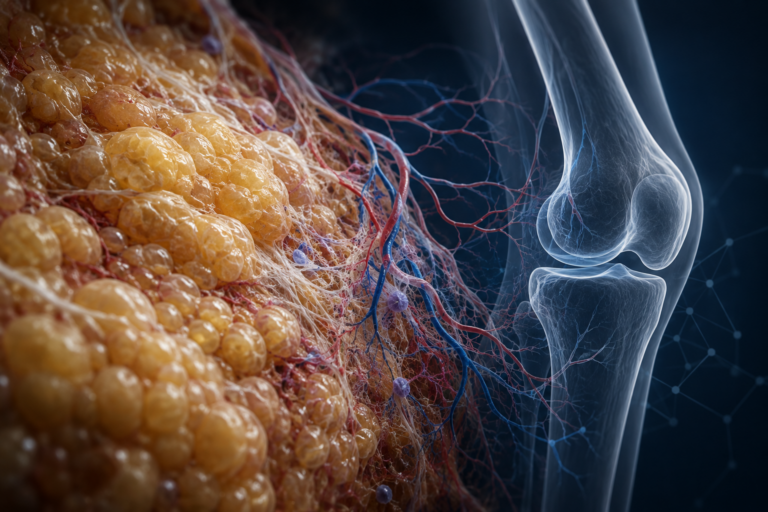
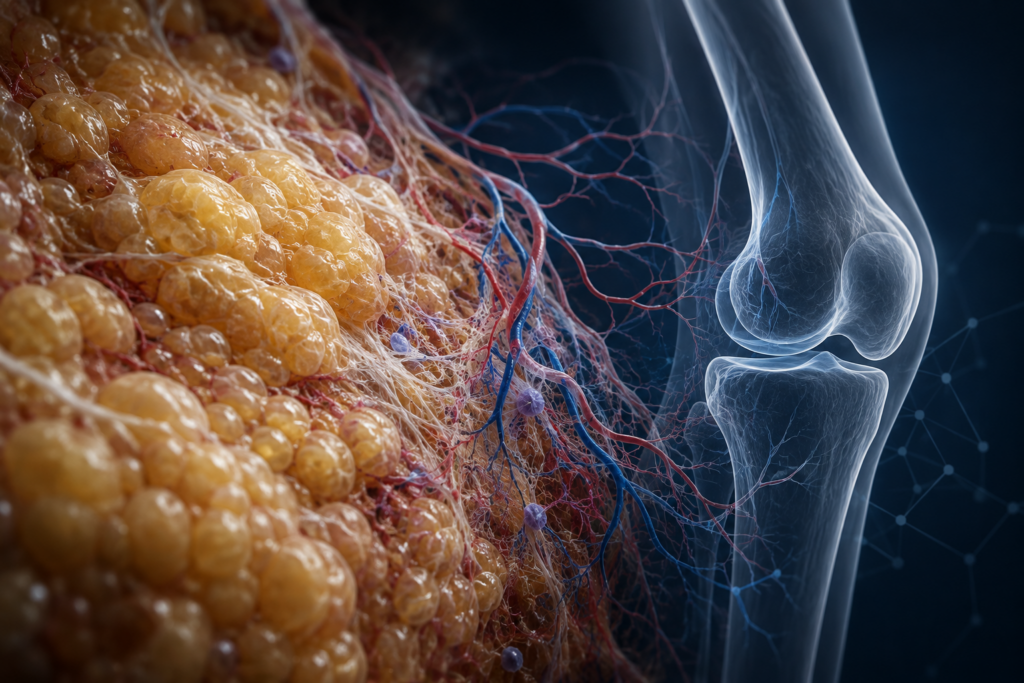
Fat is not simply a collection of adipocytes, nor is its regenerative potential adequately explained by invoking a single cell type. Adipose tissue is a complex biological system containing vascular structures, immune cells, stromal cells, extracellular matrix, progenitor populations and a wide array of signaling molecules.
Studies from Ragni and colleagues showed that mechanically microfragmented fat retains much of that tissue architecture while preserving stromal and vascular components and releasing signals associated with anti-inflammatory and cartilage-protective activity.3
Guo and colleagues similarly demonstrated sustained anti-inflammatory and pro-angiogenic activity from microfragmented adipose tissue in laboratory studies.4
Taken together, this is why I increasingly think about fat as a biological system, rather than simply a reservoir of “stem cells.”
That distinction matters.
Processing Matters
One of the questions our group has spent years studying is whether all mechanically processed fat should really be thought of as the same thing.
The answer appears to be no.
Our work at UC Irvine has shown that the mechanics of processing can influence the cellular composition and biological characteristics of the resulting adipose tissue. We have demonstrated improved enrichment of certain stromal and progenitor populations compared with traditional manual nanofat processing, and more recently showed that controlled shear conditions can influence endothelial progenitor enrichment and angiogenic activity in vitro.5,6
Importantly, this is still mechanical processing of a patient’s own adipose tissue. The point is not that we are “creating” something new, but that the way tissue is resized, washed and mechanically handled can influence the characteristics of the tissue we return to the patient.
That, in my view, is one of the most important emerging ideas in adipose therapeutics.
For years, terms such as nanofat and microfragmented fat have often been treated as though they describe standardized products. In reality, different processing methods expose tissue to different mechanical forces, produce different fragment sizes, and may preserve or enrich different biological components.
The next phase of the field will be about understanding those differences and improving consistency.
Where This Is Going
More than five years ago, Ghiasloo and colleagues reviewed the expanding clinical applications of mechanically processed adipose tissue and concluded that the field still needed better answers around optimal processing, dosing and mechanism of action.7
We still do.
But the quality of the evidence is improving. We now have stronger randomized clinical data in advanced osteoarthritis, longer-term follow-up suggesting durable benefit in selected patients, and a growing mechanistic literature helping us understand why adipose tissue may have regenerative effects in the first place.
For me, the most interesting question is no longer whether fat has regenerative potential.
The more important question is how we can preserve and reproducibly harness that potential.
That question has driven much of our work at Sayenza, and studies like Varone’s make me increasingly optimistic about where the field is headed.
Fat is the future.
- Varone BB, Leite CBG, Pagotto VPF, Giglio PN, Gobbi RG, Demange MK. Micro-fragmented adipose tissue provides durable 1-year relief in advanced knee osteoarthritis: a double-blind randomized controlled trial. Journal of Cartilage & Joint Preservation. 2026. doi:10.1016/j.jcjp.2026.100315.
- Heidari N, Borg TM, Olgiati S, et al. Microfragmented Adipose Tissue Injection (MFAT) May Be a Solution to the Rationing of Total Knee Replacement: A Prospective, Gender-Bias Mitigated, Reproducible Analysis at Two Years. Stem Cells International. 2021;2021:9921015. doi:10.1155/2021/9921015.
- Ragni E, Viganò M, Torretta E, et al. Characterization of Microfragmented Adipose Tissue Architecture, Mesenchymal Stromal Cell Content and Release of Paracrine Mediators. Journal of Clinical Medicine. 2022;11(8):2231. doi:10.3390/jcm11082231.
- Guo B, Sawkulycz X, Heidari N, Rogers R, Liu D, Slevin M. Characterisation of Novel Angiogenic and Potent Anti-Inflammatory Effects of Micro-Fragmented Adipose Tissue. International Journal of Molecular Sciences. 2021;22(6):3271. doi:10.3390/ijms22063271.
- Lombardo JA, Banyard DA, Widgerow AD, Haun JB. Fluidic Device System for Mechanical Processing and Filtering of Human Lipoaspirate Enhances Recovery of Mesenchymal Stem Cells. Plastic and Reconstructive Surgery. 2023;151(1):72e–83e. doi:10.1097/PRS.0000000000009798.
- Lombardo JA, Banyard DA, Zalazar D, et al. Mechanical Processing of Lipoaspirate With a Fluidic Device Platform Promotes Wound Healing Transcriptional Programs and Angiogenesis In Vitro. Aesthetic Surgery Journal. 2025. doi:10.1093/asj/sjaf055.
- Ghiasloo M, Lobato RC, Díaz JM, Singh K, Verpaele A, Tonnard P. Expanding Clinical Indications of Mechanically Isolated Stromal Vascular Fraction: A Systematic Review. Aesthetic Surgery Journal. 2020;40(9):NP546–NP560. doi:10.1093/asj/sjaa111.